
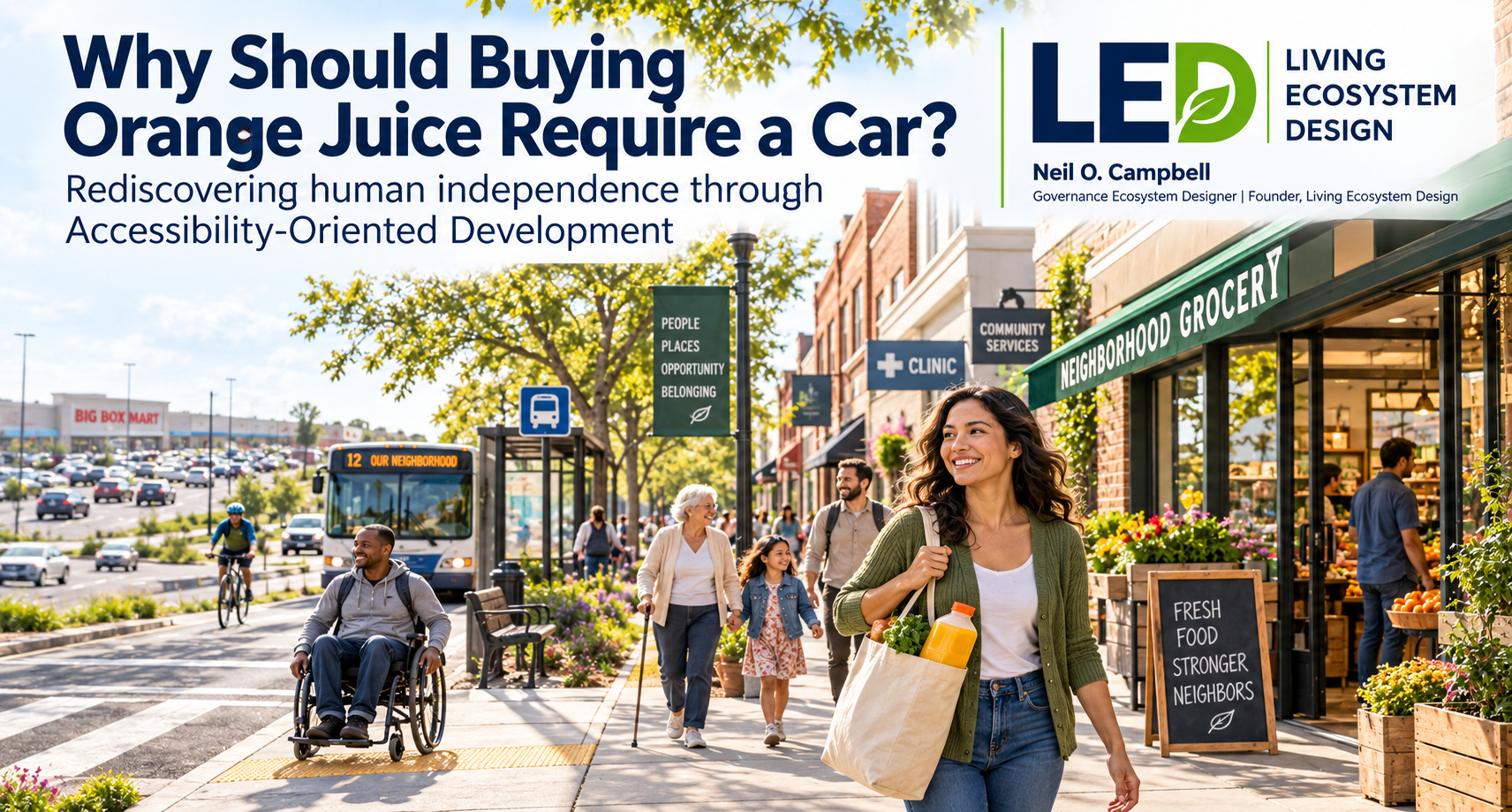
Why Should Buying Orange Juice Require a Car?
By Neil O. Campbell | Governance Ecosystem Designer and Founder, Living Ecosystem Design
Growing up in Harlem, New York, I learned something about how cities work long before I understood the language of urban planning. A few extra blocks to the grocery store could make all the difference, especially when carrying heavy bags home. Distance wasn't just something measured on a map. It was something we felt in our legs, our arms, and our everyday decisions.
Today, we have extraordinary technologies that allow us to travel farther and faster than ever before. Yet something as simple as buying a jug of orange juice can still require a car. But what happens when someone cannot afford the car, the gas, or the insurance?
Perhaps the next great advancement in how we develop our communities isn't about moving people farther and faster. Perhaps it's about rediscovering how to bring more of everyday life within human reach.
What if the places we already have hold more of the answers than we realize?
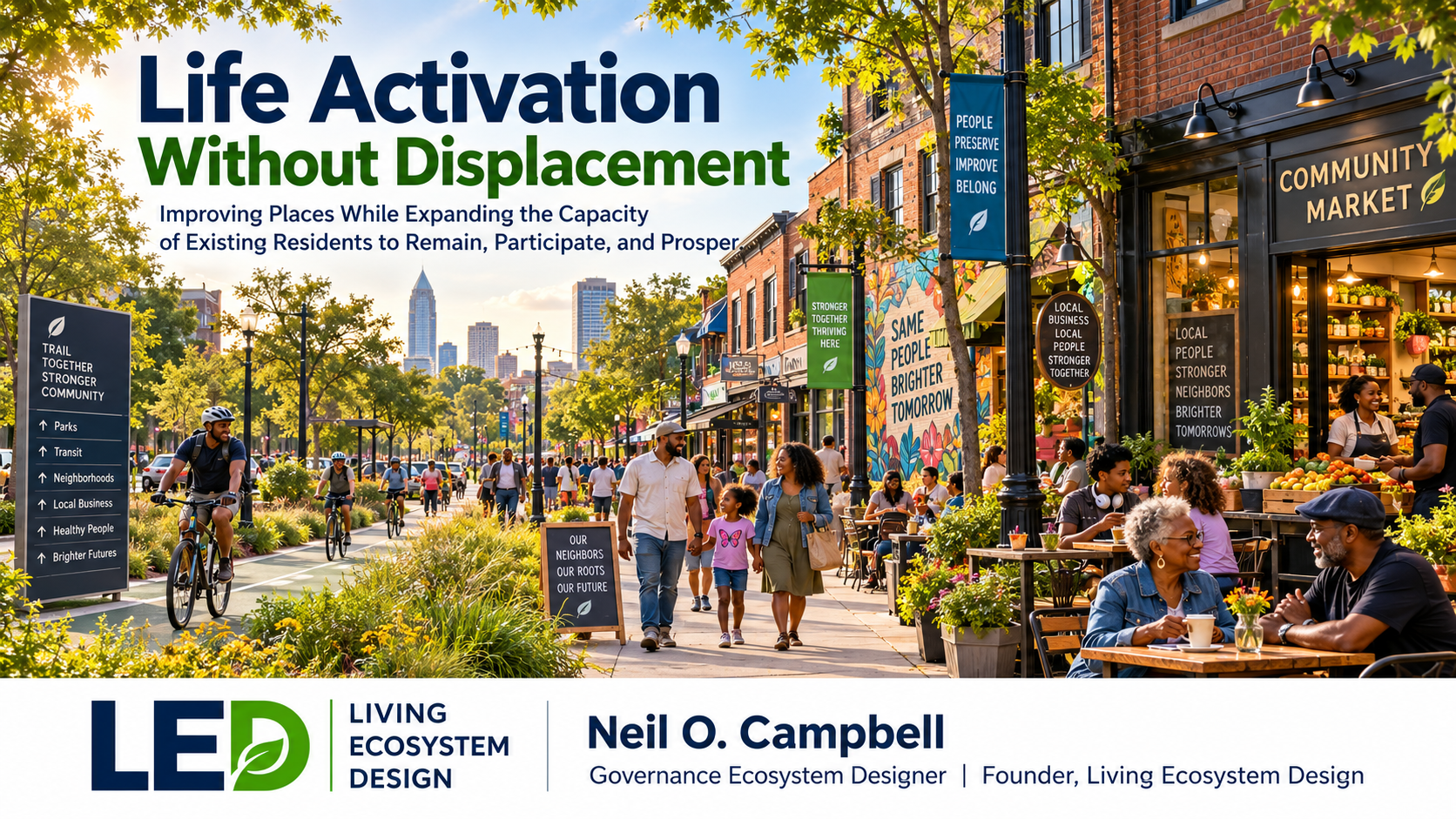
Why Do Our Cities Have Sidewalks but So Little Street Life?
By Neil O. Campbell
Governance Ecosystem Designer and Founder, Living Ecosystem Design
Why do our cities have sidewalks, yet so many streets remain empty of human activity? Sidewalks alone do not create vibrant, walkable communities. Through the lens of Living Ecosystem Design, this article explores how urban planning, accessibility, placemaking, and local economic activity can transform underutilized streets into thriving public spaces. It challenges us to rethink how we activate the built environment, strengthen neighborhood economies, and create meaningful street life without displacing the residents and communities that already give these places their identity.
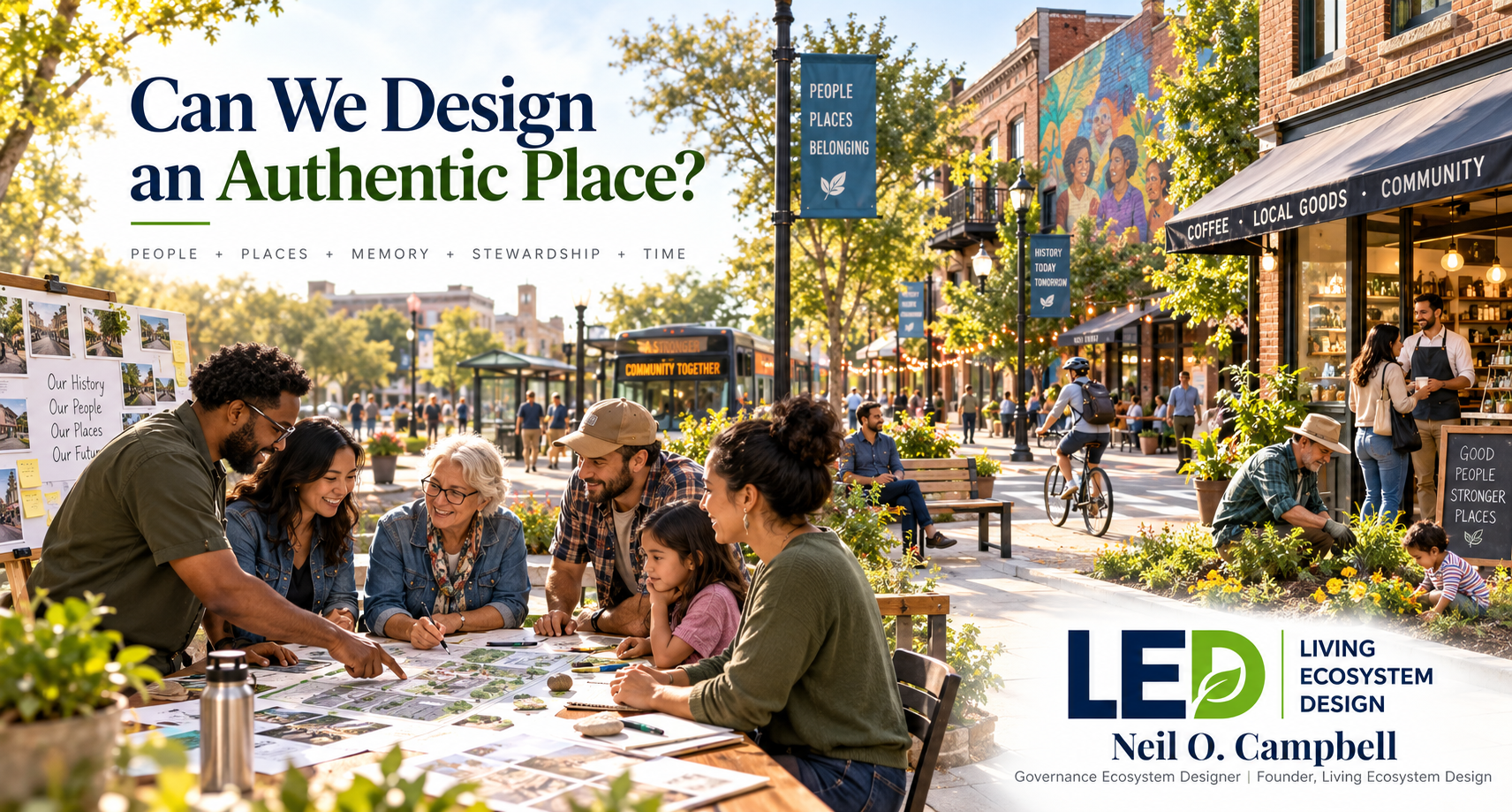
Can We Design an Authentic Place?
By Neil O. Campbell
Governance Ecosystem Designer and Founder, Living Ecosystem Design
What if the most memorable places are not those designed to impress us, but those where people have lived, connected, adapted, and created lasting memories over generations? Architecture, streetscapes, public spaces, and investment can attract people, but can they manufacture the culture, relationships, and sense of belonging that make a place truly authentic? This article explores the distinctions between organic, curated, and evolved authenticity while challenging conventional assumptions about placemaking and the role of urban designers. It also examines why attracting people and capital is not the same as retaining them, and how thoughtful planning, community participation, and long-term stewardship can create the conditions for meaningful places to emerge, evolve, and endure without losing the people and cultural foundations that give them life.
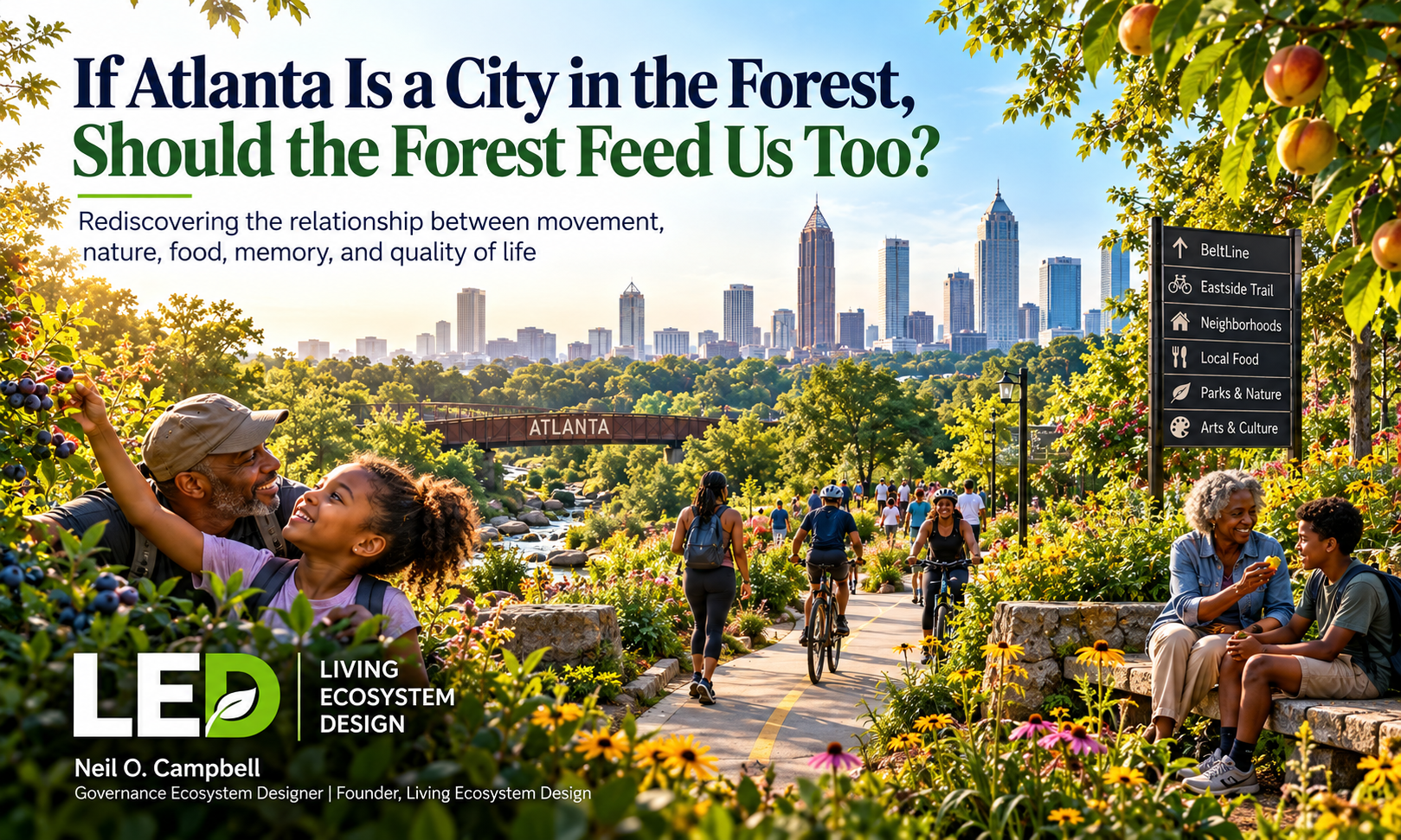
If Atlanta Is a City in the Forest, Should the Forest Feed Us Too?
By Neil O. Campbell
Governance Ecosystem Designer and Founder, Living Ecosystem Design
What if one of the most important things we can restore in our neighborhoods is not a building, street, or park, but the everyday conditions that help people become neighbors? The built environment cannot manufacture community values, but it can create places where connection, stewardship, belonging, and intergenerational relationships are easier to rediscover. From the front porch to the sidewalk, trail, garden, park, and neighborhood gathering place, this article explores what earlier communities may have understood about human connection that modern development should not leave behind, and how future neighborhood improvements can build upon those enduring foundations.
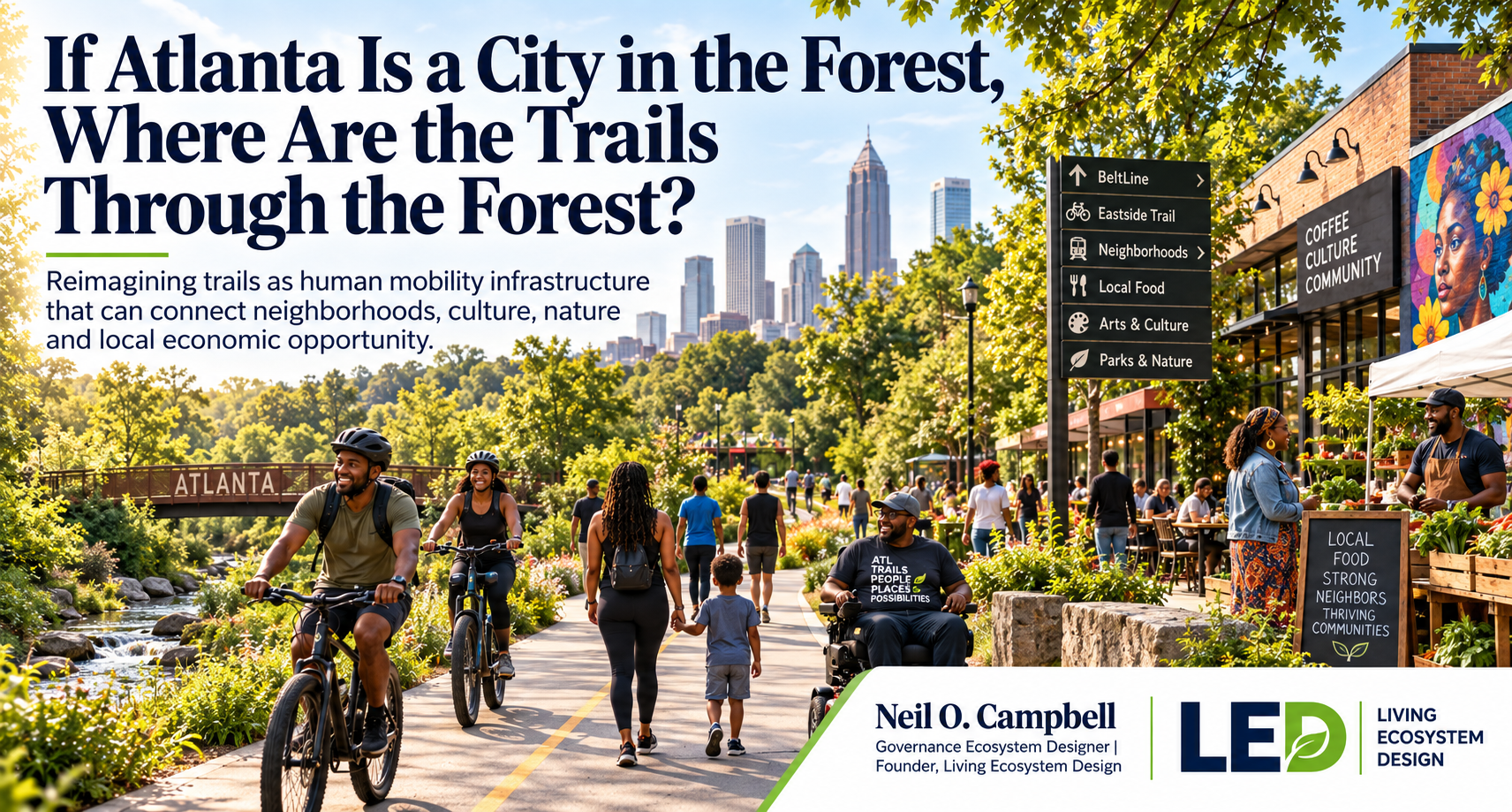
If Atlanta Is a City in the Forest, Where Are the Trails Through the Forest?
By Neil O. Campbell
Living Ecosystem Design (LED)
Atlanta is known as the “City in the Forest,” but a forest without connected trails is like a teacup without a handle. This article explores a different way of thinking about trails, not simply as recreational amenities, but as human mobility infrastructure that can connect neighborhoods, culture, commerce, nature, and emerging eco-village destinations. The opportunity may not be to build everything new, but to rediscover what already exists and connect it in a more intentional way.
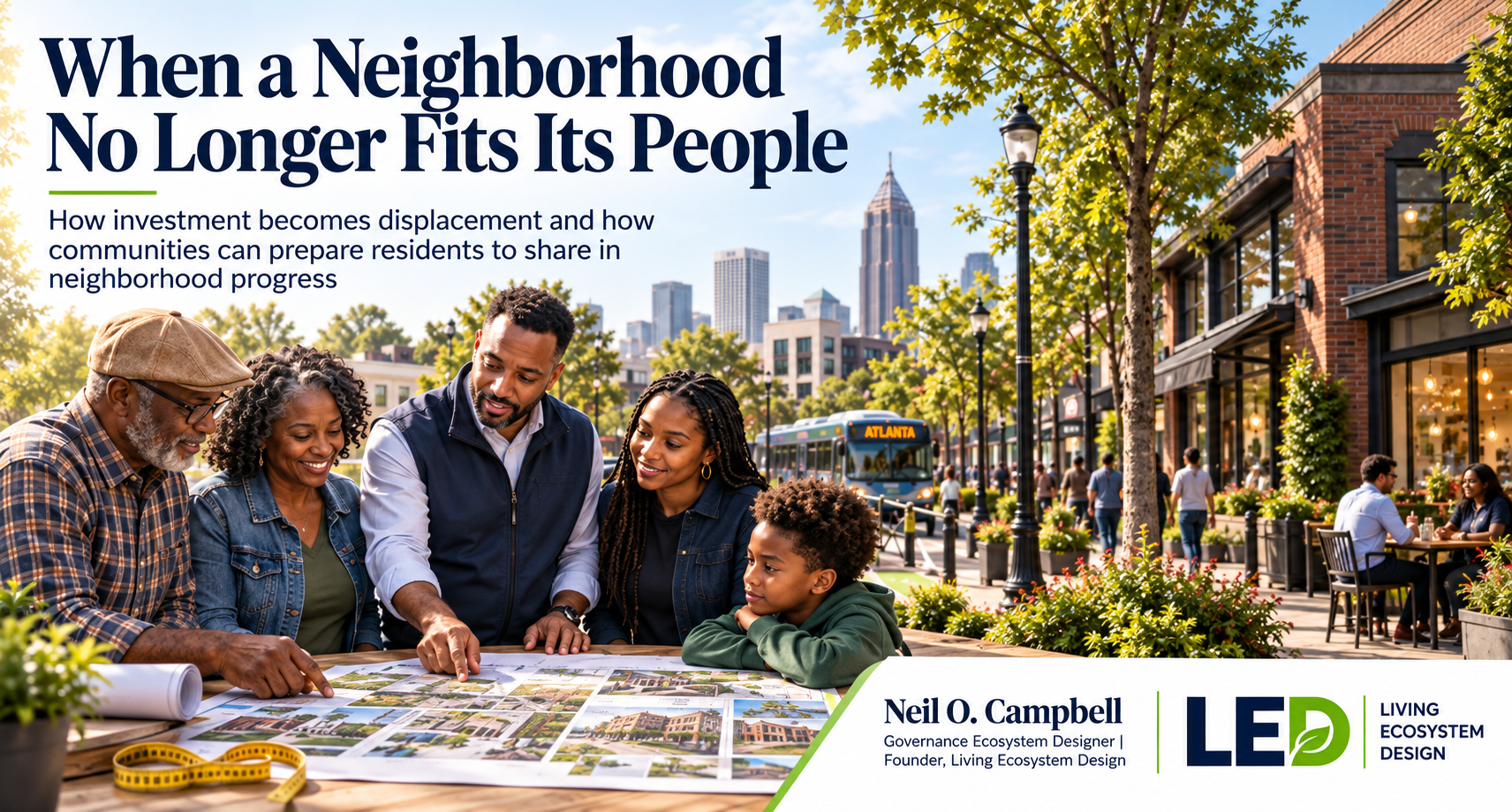
When a Neighborhood No Longer Fits Its People
How investment becomes displacement and how communities can prepare residents to share in neighborhood progress
Published September 20, 2026
Gentrification becomes a problem when neighborhood improvement raises costs beyond the reach of the people who sustained the community. Using the analogy of a Jamaican tailor who made clothing to fit the individual, this article argues that development should be tailored to existing residents, not only to future markets.
It explains how disinvestment, rising property values, income gaps, municipal pressures, and transportation decisions can transform walkability and proximity from working-class necessities into costly luxuries. It also explores how planners, public officials, developers, schools, employers, and financial institutions can develop people alongside places through housing stability, civic knowledge, career pathways, local ownership, and long-term financial preparedness.
The central message is clear: progress should be measured not only by what gets built, but by whether longtime residents can remain, participate, flourish, and share in the value being created.
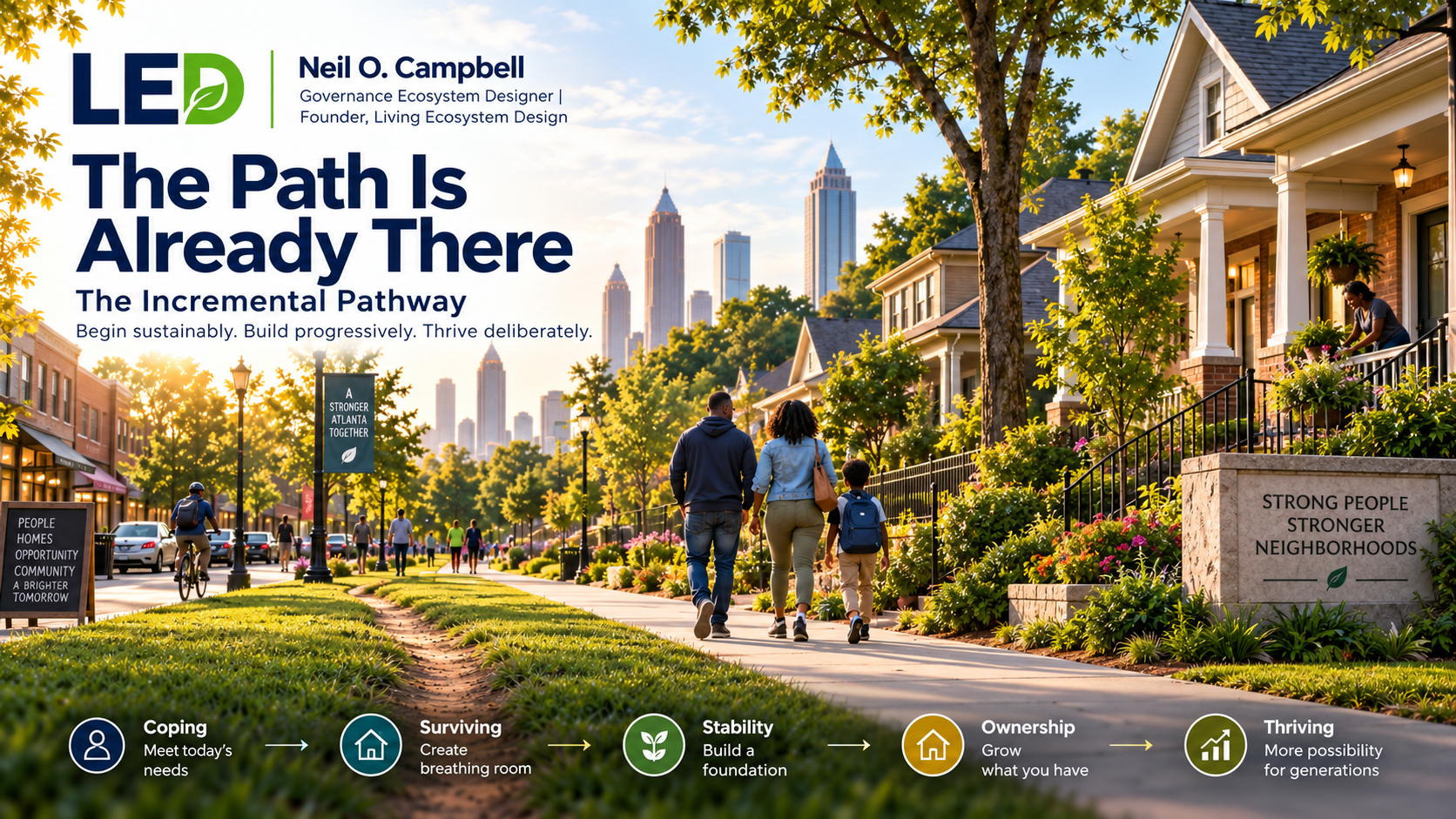
The Path Is Already There
The Path Is Already There
The Incremental Pathway: Rediscovering Human Ingenuity for Housing, Wealth, Temperament, and Thriving in America
By Neil O. Campbell | Living Ecosystem Design
Begin sustainably. Build progressively. Thrive deliberately.
A worn footpath across a lawn is not defiance. It is data. In this essay, I trace that idea from a desire path at Florida A&M through incremental housing in Chile and Jamaica, rotating savings circles, and a hard-won lesson on temperament, to argue that America can build a lawful pathway from coping to stability to ownership, one increment at a time.

The Housing We Already Have: Rediscovering the Overlooked Capacity of Ranches, Bungalows, and Existing Neighborhoods
Written by Neil O. Campbell
Founder and Governance Ecosystem Designer
Living Ecosystem Design (LED)
A Civic Innovation and Urban Systems Platform
Atlanta Metropolitan Area, Georgia
Many communities are searching for new answers to today’s housing crisis while overlooking one of the most valuable resources already available: the homes and neighborhoods we have inherited. Ranches, bungalows, duplexes, terrace levels, garages, and established residential lots often contain far more housing capacity than we recognize.
In The Housing We Already Have, Neil O. Campbell introduces the idea of Housing Sufficiency and explores how preserving, improving, recovering, and thoughtfully adapting existing homes can expand attainable housing choices while strengthening household financial resilience. Rather than assuming every solution must begin with new construction, the article asks communities and households to reconsider the lifetime cost, adaptability, infrastructure advantages, and generational value already embedded in existing neighborhoods.
The challenge may not always be discovering new housing. Sometimes it is rediscovering the capacity already standing on the block and stewarding it wisely.

The Human Planet: Rediscovering Our Shared Home
LIVING ECOSYSTEM DESIGN · HUMAN SERIES
Seventh Installment, following The Human Nation
Human Planet
Rediscovering Our Shared Home
Neil O. Campbell
Governance Ecosystem Designer | Founder, Living Ecosystem Design
I was nine years old when I boarded a plane in Jamaica and became, before I understood what the word meant, an immigrant. The decision was not mine. Adults who loved me made it on my behalf, for reasons that were theirs to weigh. I arrived in the United States carrying a birth certificate that said one thing and a childhood that was already asking a question no document could answer: what makes somewhere home?
That question has followed me through every chapter of my professional life, from architecture school to city government to the founding of Living Ecosystem Design. It sat underneath every article in this Human Series, even when I was writing about permitting timelines, neighborhood design, or regional governance. It is the question this final article is finally ready to answer, not with a conclusion, but with a proposition I have been building toward for years.
My body may have a national origin, but my soul does not.
Read the full article →

The Human Nation: Why America's Greatest Design Challenge Is Unity
LIVING ECOSYSTEM DESIGN · HUMAN SERIES
Sixth Installment, following The Human State
The Human Nation
Why America’s Greatest Design Challenge Is Unity
Neil O. Campbell
Governance Ecosystem Designer | Founder, Living Ecosystem Design
The United States is often measured by geography, military power, or economic output. Those measures miss what makes the country such an instructive experiment in nation-building: few places have assembled within one national ecosystem such a broad representation of humanity's cultures, ancestries, traditions, knowledge, and aspirations. That assembly is not, by itself, an achievement. It is raw material, extraordinary and largely unrealized potential to become what Living Ecosystem Design calls a Human Nation, a country that learns to organize its diversity into shared strength rather than letting it remain fragmented or merely tolerated.
This is not a claim that America has already arrived, or that it is the only nation capable of getting there. It is examined here because its scale, constitutional framework, history of migration, and institutions make it an unusually instructive case. A Human Nation requires more than diversity. It requires integration as a design challenge, stewardship as an operating principle, and a shared civic language built around liberty, dignity, opportunity, responsibility, and accountability, one that lets many peoples and many histories cooperate within one civic project without surrendering the identities that give the nation its capacity.
The essay traces that challenge from the Constitution's unfinished promise of “a more perfect Union” through Lincoln, King, and Young, and grounds it in a working systems principle: integration does not require centralization, it requires coordinated specialization, illustrated through metropolitan Atlanta's patchwork of jurisdictions functioning as one interdependent body. It also names honestly the recurring cycle by which groups who once struggled for opportunity can, after gaining it, forget the conditions that made the struggle necessary.
The Human Nation is not defined by where its people come from. It is defined by what they choose to build together, and by whether a nation built from many peoples can learn to coexist as productively within itself as it must one day learn to coexist within a shared planet.

The Human State: Stewardship of the Living Ecosystem
LIVING ECOSYSTEM DESIGN · HUMAN SERIES
Fifth Installment, following The Human Family
The Human State
Stewardship of the Living Ecosystem
Neil O. Campbell
Governance Ecosystem Designer | Founder, Living Ecosystem Design
A state is more than a government or a set of political boundaries. It is a living ecosystem of people, families, institutions, infrastructure, and natural resources, and its health depends on how well those systems steward what has been entrusted to them. In The Human State, the fifth installment in the Living Ecosystem Design Human Series, Neil O. Campbell uses Georgia to explore a question that applies to any state: not simply what the state can provide, but how individuals, institutions, and communities become better stewards of the ecosystem they share.

The Human Family: How to Discover Your Place in a Healthy Family
LIVING ECOSYSTEM DESIGN · HUMAN SERIES
The Human Family: How to Discover Your Place in a Healthy Family
By Neil O. Campbell
Governance Ecosystem Designer | Founder, Living Ecosystem Design
We tend to assume family is something we simply have, like a birthplace or a surname. But the family that shapes a life is not the one recorded on a certificate; it is the one that shows up, tells the truth, keeps its word, and protects the weak. In the latest essay from the Living Ecosystem Design Human Series, Neil O. Campbell examines the family as humanity's first living ecosystem: the first place we learn whether power protects or controls, whether love is dependable or conditional, and whether belonging requires honesty or self-erasure. Healthy families, he argues, are not guaranteed by blood. They are discovered, rediscovered, cultivated, repaired, and stewarded, one generation at a time. A reflection on belonging, responsibility, and what it takes to leave a family stronger than we found it.

The Human Community: The Most Overlooked Infrastructure in Society
The Human Community
The Most Overlooked Infrastructure in Society
Modern society spends billions of dollars building roads, bridges, buildings, utilities, and technology. Yet it invests comparatively little in the invisible infrastructure that determines whether people actually thrive.
Roads move automobiles. Pipelines move water. Power grids move electricity. Digital networks move information.
Communities move human potential.
Without community, every person becomes an independent survival project. With community, every person's success becomes a shared investment.
We have learned to measure a region by what a helicopter can photograph: the skyline, the interchange, the stadium, the port. Those things matter. But they are only the visible half of a city. The other half cannot be photographed at all. It is the network of relationships that decides whether a newcomer finds a mentor, whether a struggling family finds a hand to hold, whether a young person with a rare gift finds someone who recognizes it early enough to matter.
That network is infrastructure too. We have simply forgotten to build it on purpose.
Neil O. Campbell, Founder and Strategic Thinker · Living Ecosystem Design (LED)

The Human City: Designing Cities Around Human Flourishing
THE HUMAN SERIES
By Neil O. Campbell Founder & Strategic Thinker
AN INSIGHT FROM LIVING ECOSYSTEM DESIGN (LED) / PART OF THE HUMAN SERIES
A Civic Innovation and Urban Systems Platform Atlanta Metropolitan Area, Georgia
The Human City
Designing Cities Around Human Flourishing
For most of modern history, we have measured cities by what they accumulate. We count buildings and permits. We count tax receipts, budget lines, and square footage. We celebrate skylines as though the skyline were the purpose of a city rather than a consequence of one. Yet a city has never been a collection of structures. A city is a collection of lives.
The Human City begins with a single correction. A city should not measure its success by the number of buildings it constructs, the taxes it collects, or the size of its budget. A city should measure its success by how effectively it improves the human experience. Everything else is a means. The human being is the end.
At Living Ecosystem Design, we hold that a city is a living ecosystem. Every department, every policy, every investment, and every public service is an organ within that ecosystem, and each exists for one purpose: to help people thrive. When we accept this premise, the work of government changes character. Budgets become instruments of human outcomes rather than ends in themselves. Zoning becomes a question of human access. Infrastructure becomes a question of human time. The city stops being a machine to be optimized and becomes a habitat to be cultivated.
The Human City rests on three foundational principles. Proximity, one of the most overlooked forms of public infrastructure, because every unnecessary mile between people and what they need is a hidden tax paid most of all in time. Prosperity, created through deliberate policy rather than chance, treating every resident first as a human asset capable of contributing value. And Safety, defined far beyond policing, delivered every time government responds quickly to a problem instead of leaving a resident to feel ignored.
Cities exist because people exist. The future of urban planning is not simply the smarter city or the more sustainable city. It is the Human City, a place designed so intentionally around human flourishing that every policy, every investment, and every institution advances the same purpose.
Continue reading the full article.

The Human Region: Why the Future Will Belong to Regions That Celebrate Humanity
THE HUMAN REGION
Why the Future Will Belong to Regions That Celebrate Humanity
By Neil O. Campbell
Founder & Strategic Thinker
A LIVING ECOSYSTEM DESIGN (LED) STRATEGIC ANALYSIS
A Civic Innovation and Urban Systems Platform
Atlanta Metropolitan Area, Georgia
For generations, regions have competed to become the economic capital, the technology capital, or the logistics gateway of the world. Those ambitions remain important. But the greatest competitive advantage of the twenty-first century may be something far more profound: becoming the best region on Earth to be human.
The Human Region is not defined by ethnicity, race, religion, ideology, or nationality. It is defined by one shared identity, our humanity. And when we design our institutions around that truth, nearly every system, from housing and transportation to healthcare and public administration, begins to look different.
Living Ecosystem Design views a region not as a collection of competing jurisdictions but as a single living organism. Just as the human body cannot flourish when one organ succeeds while another fails, a region cannot thrive when one community prospers while another is left behind.
Atlanta has not yet arrived at this ideal. Yet few places carry a stronger legacy in the story of human dignity, or a clearer opportunity to design its next chapter around human flourishing.

The Atlanta Architecture Ecosystem: Why the World's Greatest Cities Will Be Built Through Unity, Not Individual Disciplines
Series: LED Foundational Framework Series
Publication Number: LED-SA-001
Article Type: Strategic Analysis
Author: Neil O. Campbell
Organization: Living Ecosystem Design (LED)
For more than a century, the world's great cities have been recognized for excelling in a single discipline. New York became synonymous with powerful real estate development. Chicago earned global recognition for architectural innovation. Dubai demonstrated what visionary engineering and bold imagination could achieve. Yet no major metropolitan region has intentionally united every profession responsible for shaping the built environment into one coordinated system with a shared purpose.
In this inaugural LED Strategic Analysis, Neil O. Campbell introduces the concept of the Healthy Architecture Ecosystem, a new framework that proposes the future of regional competitiveness will not be defined by individual professions, but by the strength of collaboration among architects, planners, engineers, landscape architects, developers, builders, educators, investors, public officials, and the communities they serve. Drawing on global case studies, interdisciplinary research, and Atlanta's unique assets, this article explores how the Atlanta region has the opportunity to become the first metropolitan area recognized for intentionally integrating the entire built environment ecosystem to create one of the highest quality-of-life destinations in the world.
Rather than asking which profession deserves the greatest recognition, this analysis asks a more important question: What becomes possible when every discipline works together as one living ecosystem?

The Body Knows: Why Every City Is a Living Ecosystem, and What That Means for How We Govern
By Neil O. Campbell
Founder & Strategic Thinker
A LIVING ECOSYSTEM DESIGN (LED) STRATEGIC ANALYSIS
The Body Knows: Why Every City Is a Living Ecosystem, and What That Means for How We Govern
Why do so many well-intentioned solutions fail to produce lasting improvements in our cities? A new transit line opens, yet congestion persists. Housing incentives are introduced, yet affordability continues to decline. Government agencies reorganize, but the same challenges reappear year after year.
The answer may lie in a fundamental misunderstanding of how cities actually function.
Just as no single organ can sustain the human body, no single department, policy, or infrastructure project can create a thriving community. The quality of life we experience is the result of countless interconnected ecosystems working together. When those systems are healthy and coordinated, communities flourish. When they become fragmented, the symptoms emerge as traffic congestion, housing shortages, economic hardship, declining public trust, and social instability.
In this Living Ecosystem Design (LED) Strategic Analysis, Neil O. Campbell introduces a new framework for understanding cities through one of humanity's most familiar and sophisticated systems: the human body. By drawing parallels between biological systems and the ecosystems that sustain modern communities, this article challenges readers to move beyond treating isolated problems and instead cultivate the long-term health of the entire Living Ecosystem.
The future of great cities will not be determined by how effectively they manage symptoms, but by how intentionally they strengthen the interconnected systems that make human flourishing possible.

Atlanta's Circle Parks: Transforming the Beltline into the World's Largest Living Garden of Unity
By Neil O. Campbell
Founder & Strategic Thinker
Atlanta's Circle Parks: The World's First Living Garden Network
Every great city eventually asks itself a defining question: What will future generations remember us for?
Atlanta is now standing at the threshold of that question. And unlike the cities that came before, it has something none of them possessed: a continuous 22-mile loop of former rail corridor already connecting dozens of distinct neighborhoods, already carrying millions of visitors each year.
The question is not whether this infrastructure matters. It clearly does. The question is what Atlanta chooses to make of it.
In this new LED strategic vision, Neil O. Campbell proposes transforming the Atlanta Beltline's eight trail segments into the world's first network of interconnected Circle Parks, each with its own authentic landscape identity, cultural meaning, and ecological character, all united by one continuous design philosophy. From a Native Georgia Forest Garden on the Northeast Trail to a Civil Rights Heritage Garden on the Eastside, from a Food Forest on the Southside to a Climate Resilience Garden on the Westside, the proposal offers a new global model for what cities can accomplish through the thoughtful design of public space.
This is not a parks initiative. It is a regional development strategy expressed through landscape, one where every investment in ecology, culture, and community reinforces every other.
Read the full article to explore all eight Circle Parks, the economic case for extraordinary public landscape, and why Atlanta is uniquely positioned to become the world's Living Garden City.

Stop Cutting Holes in Office Buildings: How Vertical Farming Can Unlock Millions of New Urban Housing Units
By Neil O. Campbell
Founder & Strategic Thinker
A LIVING ECOSYSTEM DESIGN (LED) STRATEGIC ANALYSIS
America's housing shortage and office vacancy crisis are often treated as separate problems. This article argues they can be solved through a single integrated strategy. Rather than spending millions cutting light wells into deep-floor-plate office buildings, the Living Ecosystem Design (LED) framework proposes a new building typology: the Residential Agricultural Tower.
By placing housing along naturally lit building perimeters and vertical farms within windowless interior cores, cities can unlock millions of potential housing units while simultaneously strengthening local food production, improving economic viability, and enhancing community resilience. The result is a building that produces housing, food, economic activity, and environmental benefits from the same footprint.
The future of urban redevelopment is not simply converting buildings. It is transforming them into living systems that work harder, generate more value, and strengthen the communities they serve.

FROM TENANT TO RENT-FREE: A 30-Year Wealth-Building Framework for the Long-Term Renter
By Neil O. Campbell
Founder & Strategic Thinker
A LIVING ECOSYSTEM DESIGN (LED) STRATEGIC ANALYSIS
What if renters treated themselves as their own equity partner?
For decades, the housing conversation has centered on a single idea: buy a home, build equity, secure your future. But for millions of long-term renters, whether by circumstance or choice that path isn't available, and the conventional narrative offers them no alternative.
The Living Ecosystem Design (LED) Rent Freedom Strategy reframes the problem. Mortgages build wealth because they force a savings mechanism into every payment. Renters have no equivalent, so LED built one: a four-step framework that simulates the principal portion of a mortgage payment, invests it consistently, converts everyday spending rewards into capital, and turns the security deposit into an investment entry point.
Run over 30 years, even modest contributions compound into six-figure and in stronger-return scenarios, seven-figure portfolios. The goal isn't to buy a house. It's to buy freedom: the financial capacity to cover housing costs without depending on a paycheck.
Housing security isn't a deed. It's a capability.