
By Neil O. Campbell
Founder & Strategic Thinker
A LIVING ECOSYSTEM DESIGN (LED) STRATEGIC ANALYSIS: A Feasibility Study of Voluntary Office-to-Living Conversion as a Strategy for Housing Affordability, Workforce Productivity, and Downtown Revitalization.
Executive Summary
America is sitting on a trillion-dollar paradox. More than one billion square feet of office space across the United States sits dark for thirteen hours each night, fully heated, cooled, secured, and maintained, while nearly half of all American renters cannot afford the homes they occupy. These two crises share a common geography, often the same building, and yet policy has treated them as entirely separate problems.
The Living Ecosystem Design (LED) framework proposes a direct response: the voluntary adaptation of select private offices within existing commercial buildings to support concurrent living and working functions, enabling employees to reside within their workplace while accessing shared building amenities. This analysis evaluates that proposal across ten research dimensions, drawing on peer-reviewed scholarship, government datasets, real estate market analysis, and city-level case studies.
The evidence indicates that the LED concept is analytically credible and precedent-supported, though it faces meaningful regulatory, operational, and cultural barriers that would require deliberate policy design to overcome. Key findings include:
• Historical grounding: Humans lived and worked in the same location for the vast majority of recorded history. The separation of home and workplace is a post-industrial phenomenon, driven primarily by steam railways after 1850 and codified by single-use zoning law beginning in 1916. The LED concept represents a return to a historically normal arrangement, not a radical departure from one.
• Office vacancy crisis: U.S. office vacancy reached 20.4% nationally in Q1 2025, the highest recorded since systematic tracking began in 1979. Atlanta’s downtown vacancy stands at 28%, with projections of 39% by 2028. Kastle Systems data indicates that less than 50% of leased office space is physically occupied during business hours; after-hours utilization approaches zero. The scale of underutilization is sufficient to justify serious pilot exploration.
• Housing cost burden: Nearly 50% of all U.S. renter households are cost-burdened, spending more than 30% of their income on housing. Modeled scenarios demonstrate that employees receiving partially or fully subsidized office-living accommodations in Atlanta could accumulate between $32,900 and $120,700 in additional net wealth over five years through combined rent savings and redirected retirement contributions.
• Transportation gains: Atlanta commuters average 32 minutes each way, ranking 5th nationally in mean commute time. At 5–20% voluntary LED adoption, Atlanta could eliminate between 30 and 120 million annual vehicle round trips, reduce CO₂ emissions by up to 310,000 tons annually, and generate $54–$216 million in annual fuel savings.
• Productivity evidence: Harvard Business School research demonstrates that every 10 km of added commute distance reduces innovative output by 5% and patent quality by 7%. Separately, near-work arrangements have been shown to produce 30 additional minutes of sleep nightly, equivalent to over 180 hours of additional rest annually.
• Regulatory pathway: Full conversion to residential occupancy would require significant code modifications. A narrower “supplemental overnight occupancy” classification applied to existing Class B and C office buildings already equipped with gyms, showers, and food service could operate under an intermediate regulatory framework achievable through a pilot ordinance rather than full residential code compliance.
• Atlanta pilot feasibility: Downtown Atlanta has 105 non-owner-occupied candidate buildings representing 20 million square feet, with 5.5 million currently vacant. The Atlanta City Hall Annex at 55 Trinity Avenue SW represents a credible government-sector pilot site given its existing amenities, proximate parkland, and walkable urban context.
• Systems-level assessment: LED is unlikely to serve as a mass-market housing solution in isolation, but as a voluntary supplemental program targeting early-career professionals, fellowship participants, and workforce housing initiatives, it has credible potential to simultaneously advance housing affordability, transportation efficiency, downtown vitality, and public infrastructure utilization.
The weight of evidence justifies pursuing a limited government-sector pilot as a first step toward evidence-based policy development. The cost of that pilot is modest; the information value of rigorous evaluation is high regardless of outcome.
Part I: Historical Context - Humans Have Always Lived Near Their Work
Pre-Industrial Live-Work Arrangements
For the overwhelming majority of human history, the separation of home and workplace was neither practical nor common. In pre-industrial Europe and North America, the shop-house a combined dwelling and commercial space was the dominant built form. Research on English market towns from 1600 onward confirms that shops were typically located on the ground floors of buildings with housing and storage above, and that this pattern remained well-established until the mid-nineteenth century. A study examining northwest English towns between 1760 and 1820 documents how small-business households routinely integrated domestic life and commercial activity within the same structure.
Analysis of a Kingston, Ontario business directory from 1857 to 1975 found near-total coincidence of homes with offices in 1857, with complete separation not achieved until the post-1950 period. Critically, that separation was found to be a gradual process over fifty years rather than a sudden wave, with mid-century automobile expansion completing what railways had begun.
The Steam Railway as the Pivotal Inflection Point
Landmark research published in the Quarterly Journal of Economics using spatially disaggregated data for London from 1801 to 1921 establishes that the invention of the steam railway triggered the first large-scale separation of workplace and residence. Before railways, slow travel times compelled most workers to live close to their employment. Steam transit allowed workers to exploit productivity advantages in city centers while living in lower-cost peripheral areas. The share of London’s thirteen inner boroughs in total workplace employment fell from 68% in 1831 to 48% by 1921.
Zoning Law and the Codification of Separation
The final institutionalization of home-work separation occurred through zoning law. New York City enacted the first comprehensive land-use regulations in 1916, and American cities broadly adopted single-use zoning through the 1920s. Zoning locked in what geography and transportation had initiated, prohibiting mixed residential-commercial uses across vast swaths of American cities and effectively criminalizing the very arrangements that had been universal for centuries.
Company Towns and the Employer-Housing Tradition
Employer-provided housing has a well-documented American history. Between the 1880s and 1930s, company towns were the pragmatic solution to housing workers near remote industrial locations. Their decline after the 1920s was driven by the automobile, rising real wages, and the New Deal’s ideological opposition to employer paternalism not by evidence that co-location of work and housing was itself ineffective.
The Return: Artist Lofts, Live-Work Zoning, and Mixed-Use Development
The 1970s SoHo artist loft movement in New York City marks the modern beginning of the live-work reconnection. Artists colonized vacant industrial buildings and eventually forced legal recognition of residential use within commercial structures. Live-work zoning codes spread nationally through the 1990s and 2000s. By 2021, live-work-play multifamily completions reached 49,100 annually quadrupling from approximately 10,000 in 2012.
The LED concept is not a radical idea. It is a refinement and extension of a centuries-old norm that was interrupted by a specific set of industrial and policy conditions and which has been returning in various forms for more than fifty years.
Part II: Office Utilization Analysis
National Vacancy and After-Hours Underutilization
U.S. office vacancy reached 20.4% nationally in Q1 2025, the highest level since systematic tracking began in 1979. The physical occupation gap is even wider: Kastle Systems’ Back-to-Work Barometer found that average weekly occupancy of leased space was only 49.8% as of 2023, implying a structural vacancy rate exceeding 50% even within technically occupied buildings.
After-hours utilization is close to zero by any credible measure. A 2024 Public Buildings Reform Board analysis found that federal agencies use just 12% of their headquarters capacity on average, with the 1.9 million square foot Department of Labor building averaging 441 workers on any given day. The vast majority of office space in the United States sits empty from approximately 6:00 PM to 7:00 AM daily, a thirteen-hour window representing 54% of every 24-hour cycle.
Atlanta Office Market Conditions
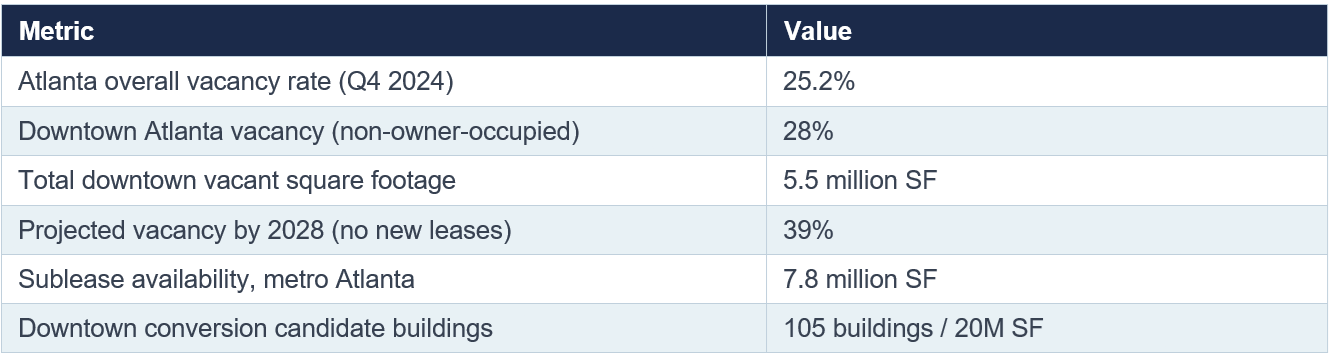
Atlanta Office Market Conditions
Atlanta is notably one of the nation’s leading office-to-residential conversion markets. The 51-story Georgia-Pacific Center and the 2 Peachtree building have both attracted conversion proposals, placing Atlanta as the sixth-largest office repurposing market nationally as of early 2025.
The Economic Cost of Underutilization
At 20.4% national vacancy, approximately 1.1 billion square feet of U.S. office space sits unused. At an average net effective office rent of $30–50 per square foot nationally, the annual economic cost of vacant office space is estimated at $33–55 billion in foregone productive use. The 5.5 million square feet vacant in downtown Atlanta alone, at $25 per square foot average rent, represents approximately $137 million in annual economic displacement before accounting for the accelerating depreciation of neglected properties and erosion of commercial property tax revenue.
Part III: Housing Affordability - The Convergent Crisis
National Cost Burden Landscape
The 2023 American Community Survey confirmed that over 21 million renter households representing 49.7% of all U.S. renters spent more than 30% of their income on housing costs, the federally defined cost-burden threshold. A record 12.1 million renter households were severely cost-burdened in 2022, spending more than 50% of income on housing. As of April 2025, national median asking rent stood at $1,699, with renters spending 23.4% of median household income, down from a peak of 24.7% the prior year, but still historically elevated.
Atlanta-Specific Affordability Conditions
Atlanta’s affordable housing crisis is well-documented and institutionally recognized. Georgia faces a shortfall of over 80,000 low-income housing units. Mayor Dickens has set a target of building or preserving 20,000 affordable units by 2030. Invest Atlanta maintains active financial incentives for workforce housing development, including the Housing Opportunity Bond Fund and the Beltline Affordable Housing Trust Fund. Downtown Atlanta residential rents average approximately $2.00 per square foot, roughly 25% below Midtown indicating both pent-up demand and cost-sensitivity in the urban core.
Modeled Wealth Accumulation Scenarios
The following model assumes a 25-year-old early-career professional earning Atlanta’s median household income (~$63,000/year), currently spending 30% of gross income ($1,575/month) on rent, with savings redirected to a compounding retirement account at 5% annually.
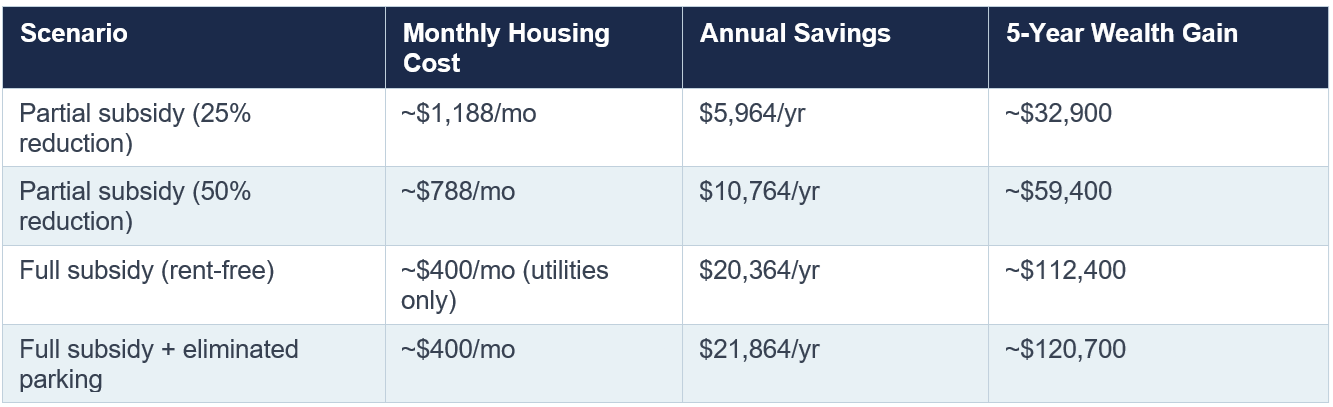
Model Wealth Accumulation Scenarios
Even at the most conservative scenario, a 25% rent reduction, a participant redirecting annual savings into a Roth IRA would accumulate approximately $32,900 over five years. Under full subsidy, the same participant could accumulate more than $120,000 in inflation-adjusted wealth. For early-career workers carrying student debt or building emergency reserves, this represents a structurally transformative financial position.
Part IV: Transportation Efficiency and Traffic Reduction
Baseline Atlanta Commute Data
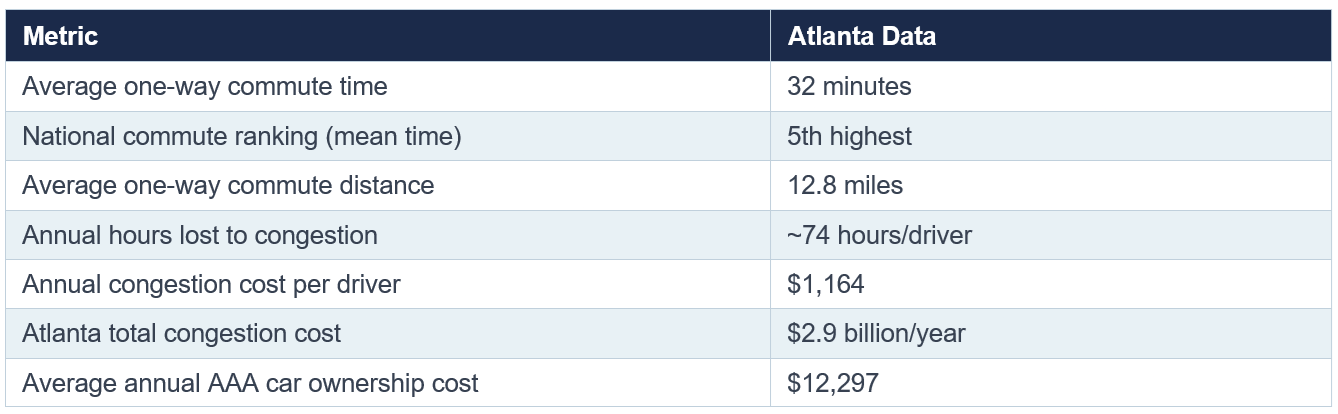
Baseline Atlanta Commute Data
LED Adoption Scenario Modeling
Metro Atlanta has approximately 2.4 million commuters. Assuming a 25.6-mile round-trip commute and 250 working days annually, each commuter generates approximately 6,400 vehicle miles per year for commute purposes alone. The following reductions are estimated at voluntary LED adoption rates of 5% through 20%:
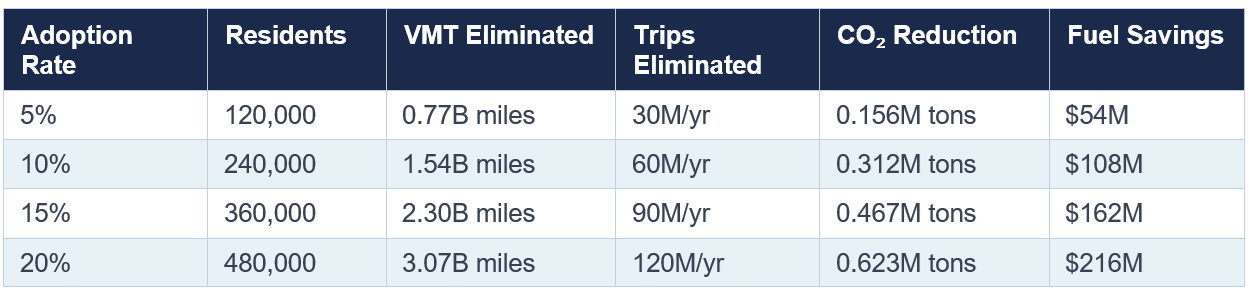
LED Adoption Scenario Modeling
Even at 5% voluntary adoption, the elimination of 30 million annual round trips would represent a measurable contribution to Atlanta’s transportation decarbonization goals. Parking demand reductions in downtown cores would produce additional infrastructure dividends, including reduced capital maintenance costs for existing parking structures.
Part V: Productivity, Wellbeing, and the Business Case for Employers
The Research Consensus on Commuting and Performance
The academic literature on commuting and workforce performance is remarkably consistent in direction, though it varies in magnitude. Four converging research streams are particularly relevant to the LED framework.
Innovative Output and Creativity
A Harvard Business School study published in the Journal of Urban Economics found that for every 10 km of added commute distance, firms registered 5% fewer patents and patent quality declined by 7%. The productivity loss was steepest among top-performing workers, those in the top 10% of their field who suffered the greatest output degradation from commuting. The lead researcher’s conclusion was direct: any reduction in commute distance translates into measurable gains in innovative productivity.
Job Satisfaction and Retention
Research by Jachimowicz and colleagues found that for every 15-minute increase in commute time, job satisfaction dropped by 0.26 points on a 1–7 scale, and that longer-commuting workers were significantly more likely to subsequently resign. Robert Putnam’s research found that each additional 10 minutes of daily commuting reduces social connections by 10%, contributing to isolation that further diminishes workplace engagement.
Commute Stress and On-the-Job Performance
A 2025 study in Transportation Research confirmed that commuting stress is significantly related to job performance, with negative emotions from stressful commutes diminishing both in-role and extra-role behaviors. A 2023 study found that anticipatory anxiety about an expected stressful commute begins reducing productivity before the employee even leaves home.
Sleep Quality and Physical Recovery
A four-year University of South Australia study, initiated before the pandemic, found that near-work arrangements produce 30 additional minutes of sleep nightly over 180 hours of additional rest annually. LED participants, by eliminating commute time entirely, could reallocate that time to sleep, recovery, and personal development.
Employer-Assisted Housing and the Retention Dividend
A 2022 National Housing Conference review of the Employer Assisted Housing (EAH) model found that Fannie Mae’s original program reduced employee turnover from over 20% to single digits, with recruiting and training cost savings covering the entire program cost. A 2024 industry survey found that 33% of employees would prefer housing benefits over a salary raise, and 41% would change employers to receive housing assistance. These figures suggest a meaningful employer-side case for LED participation that extends well beyond philanthropy.
Part VI: Downtown Revitalization and the 24-Hour City
The Evidence for Residential Downtown Activation
The International Downtown Association’s research documents the strategic importance of residential population density in sustaining 18-hour urban activity. Downtowns with permanent resident populations generate spending patterns that support restaurants, retail, and public safety during hours when office-only districts go dark. Resident density is the mechanism through which downtowns avoid becoming what urbanists call “ghost districts” after 6 PM.
Downtown Atlanta currently has approximately 6,000 residential units, with over 3,000 in the pipeline. The 2025 State of Downtown Atlanta report identified $5.2 billion in investment flowing into transformative projects including the Stitch, Centennial Yards, and South Downtown representing, by its own description, a once-in-a-generation moment of growth. LED participants, by becoming permanent residents of downtown office buildings, would directly contribute to the residential density and round-the-clock vitality that civic planners are actively seeking to build.
Case Studies from U.S. Cities
• Washington, D.C.: Arlington County’s 2024 zoning ordinance amendment created a special exception category for office-to-residential conversions, cutting approval timelines from up to one year to 120–150 days, with density bonuses for affordable housing inclusion. Federal properties represent a distinct opportunity: a GAO report found that a majority of surveyed federal agencies use 25% or less of their headquarters space.
• New York City: Manhattan’s CBD office availability rate declined from 18% at mid-2024 to approximately 14% by late 2025, outperforming the national market in part due to conversion-friendly regulatory reform under the NYC Building Code’s Article 7B framework.
• Boston: The City of Boston’s Office to Residential Conversion Program offers a 75% property tax abatement for 29 years to incentivize conversion, explicitly targeting an ‘18-hour, mixed-use downtown beyond work hours.’ The program surpassed 1,500 new homes and was extended through December 2026.
• Minneapolis: Removed public hearing requirements, reduced traffic study requirements, and exempted converted buildings from mandatory affordable housing set-asides, accelerating the conversion pipeline significantly.
Part VII: Regulatory Framework and the Path to a Pilot Ordinance
The Regulatory Gap: Office Versus Residential Occupancy
The primary regulatory barriers to LED implementation stem from the fundamental difference in building code requirements between commercial “Business” (B) occupancy and residential (R-2 or R-1) occupancy under the International Building Code (IBC).
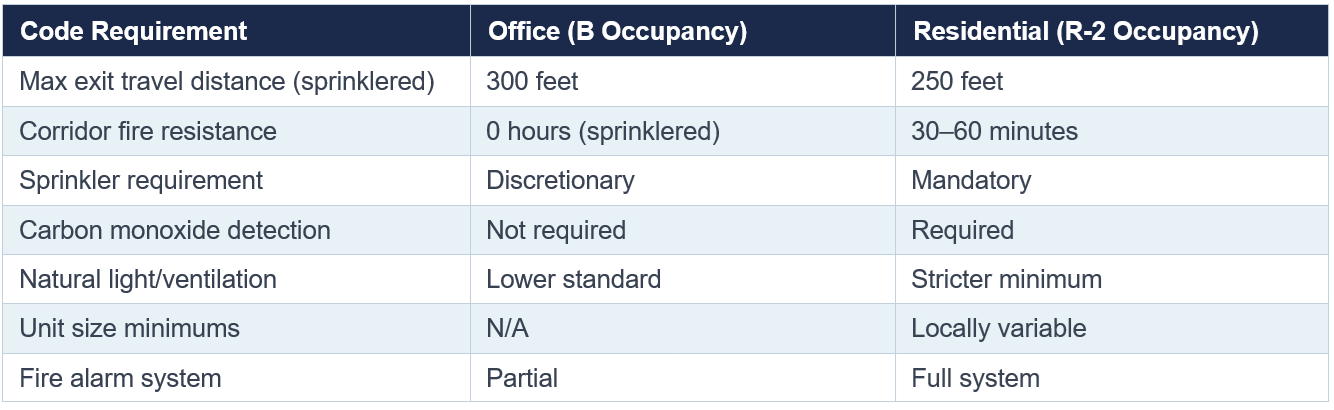
Regulatory Gap: Office Versus Residential Occupancy
A U.S. Chamber of Commerce survey found that 46% of conversion professionals cite zoning and permitting as a primary barrier, followed closely by building layouts (47%) and environmental regulations (44%).
The Path Forward: A Pilot Ordinance Architecture
A LED-specific pilot ordinance would not necessarily require full residential occupancy reclassification. An intermediate regulatory classification analogous to extended-stay hotel or dormitory occupancy (R-1 or I-1) could provide a narrower compliance pathway. This approach would require:
• Mandatory smoke and CO detection throughout any occupied suite
• Sprinkler system in any participating building
• Minimum plumbing access (dedicated bathroom per participant)
• Clear occupancy limits (one individual per private office suite)
• Annual health and safety inspection
• Voluntary opt-in by both employer and employee
• Explicit labor law exemptions no compensation for “living on premises” time
• Minimum 30-day housing continuation guarantee upon employment termination
Under this framework, legislative change at the state or local level would be required to create the new occupancy classification, but full residential code compliance the most expensive element of any conversion could be deferred pending evidence from the pilot. The standard for success should be: would a reasonable resident sleep safely in this space? Not: does this space meet every standard designed for permanent multi-unit residential construction?
Part VIII: Adaptive Reuse Precedents and Lessons from Practice
The Conversion Landscape
The National Association of Realtors estimated in 2021 that 22 of 27 major U.S. metros affected by pandemic-era vacancy had market conditions making office-to-housing conversion financially feasible, with 43,500 housing units producible if 20% of vacant square footage were converted. Class B office buildings account for 77% of conversion candidates given lower acquisition costs and structural adaptability.
Gensler’s 2025 framework report for optimizing conversion policies identifies four levers: regulatory flexibility, financial incentives, demand-driven strategies, and targeted subsidies. The Brookings Institution’s 2025 analysis confirms that historic preservation tax credits remain the most impactful single financial tool for conversion feasibility.
Key Precedent Models
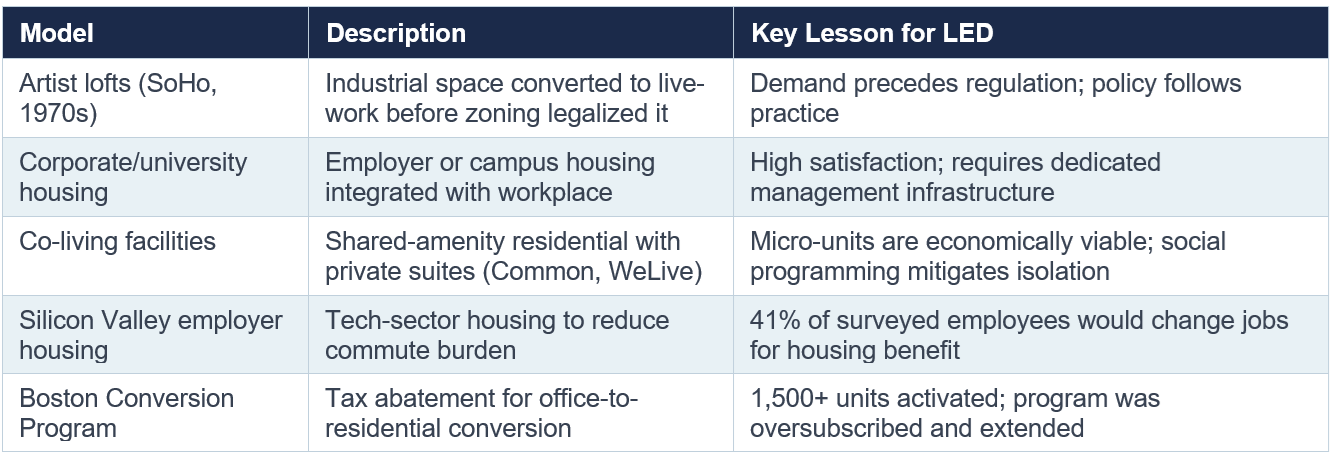
Key Precedent Models
Critical Design Lessons
Three lessons from failed or problematic conversions are equally instructive for LED design:
• Deep-plate buildings are difficult to adapt. The absence of natural light and ventilation in interior zones creates habitability problems. LED pilots should prioritize perimeter-plate buildings with operable or accessible windows.
• Isolation without community programming is a retention problem. Co-living failures frequently trace to inadequate social infrastructure. LED programs should include structured communal amenities, communal meal options, and opt-in social events.
• Employer-tenant conflicts require clear legal architecture. The boundary between employment and tenancy must be explicitly legislated to prevent wage-law violations, constructive dismissal claims, and housing insecurity triggered by employment changes.
Part IX: City of Atlanta Pilot Opportunity
Existing Conversion Activity and Market Context
Atlanta has emerged as the nation’s sixth-largest market for office-to-residential conversion. Two Peachtree Street a 41-story, 714,000 square foot building currently 80% vacant has advanced conversion plans to create over 600 residential units. The Downtown Atlanta Commercial-to-Residential Conversion Study identified 105 non-owner-occupied candidate buildings across 20 million square feet, with current downtown vacancy at 28% and 13 buildings already exceeding 50% vacancy.
City Hall Annex: A Credible Government-Sector Pilot Site
The Atlanta City Hall Annex, located at 55 Trinity Avenue SW in the heart of Downtown Atlanta, presents a compelling candidate for a first LED pilot. It operates within standard government business hours, leaving the physical space largely empty for more than thirteen hours each night. Its surrounding context includes walkable access to Woodruff Park (0.1 miles), MARTA Five Points Station (0.2 miles), the Atlanta BeltLine via transit, and multiple downtown restaurants and fitness facilities within a short walk.
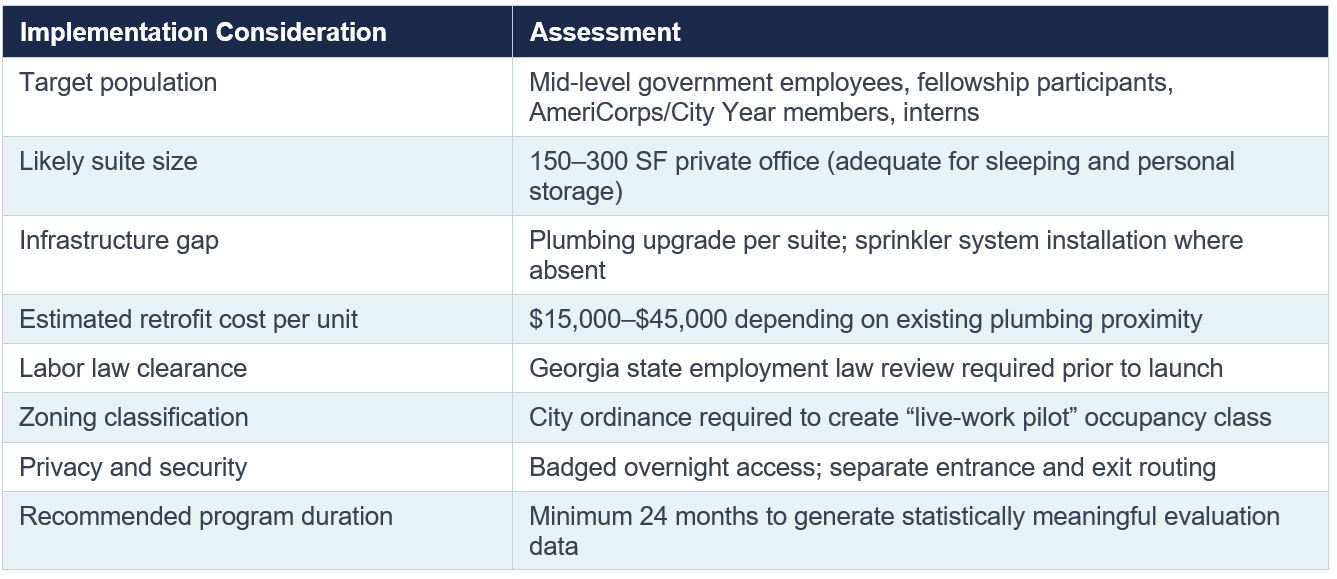
City Hall Annex Pilot
The city’s own affordable housing goals 20,000 units by 2030 provide direct political rationale for a public-sector pilot that demonstrates the model before private-sector scaling. Mayor Dickens’ established affordable housing agenda, combined with the Invest Atlanta Housing Opportunity Bond Fund as a potential source of fit-out capital, creates a viable institutional pathway.
Proposed Pilot Structure
• Participants: 10–25 volunteers (City employees, AmeriCorps/City Year fellows, or summer program participants)
• Duration: 24 months with quarterly evaluation checkpoints
• Subsidy model: No rent charged; participant covers food and personal expenses
• Amenity plan: Negotiate gym access within the building or at the nearby YMCA (0.3 miles); designate dedicated shower facility
• Data collection: Weekly surveys measuring sleep quality, productivity, financial savings rate, commute elimination, and overall wellbeing
• Evaluation criteria: Participant would-you-repeat rate, supervisor productivity assessment, documented financial savings, and city cost per participant served
Part X: Systems-Level Assessment
LED Evaluated Across Eight Systems Dimensions
The LED concept can be evaluated against eight systems-level outcomes. This section synthesizes the evidence across all prior sections into an integrated assessment.
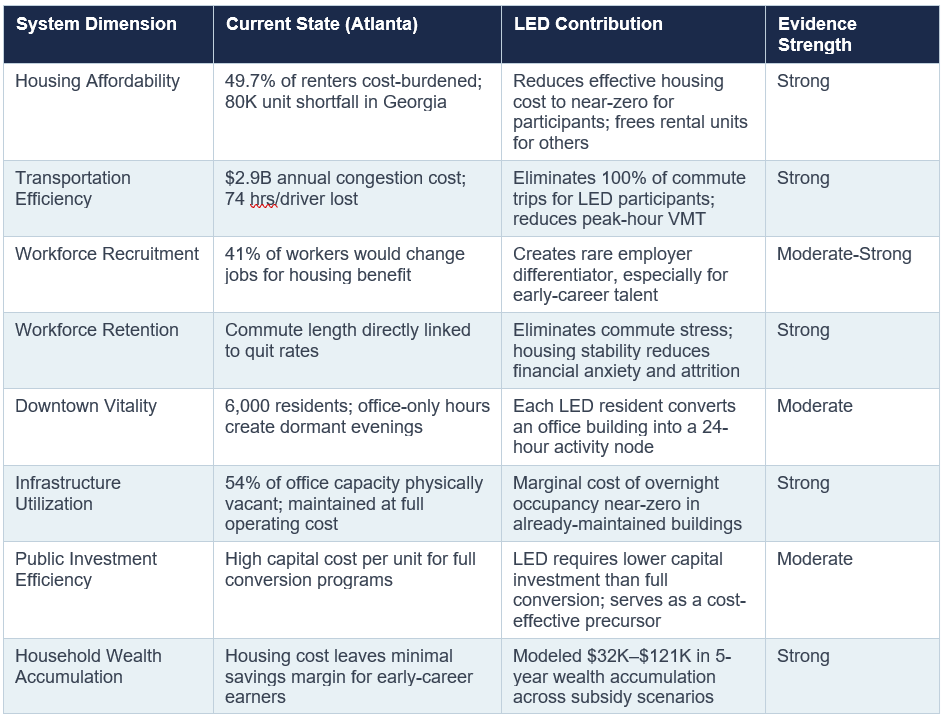
Eight Systems Dimensions
Counterarguments and Structural Limitations
The LED concept is not without legitimate objections, and intellectual honesty requires their direct engagement.
• Work-life boundary erosion. Residing in the workplace may blur professional and personal identity, increasing risk of overwork, surveillance anxiety, and burnout. This is the most serious behavioral concern and requires deliberate policy countermeasures: mandatory off-hours access restriction, clear right-to-disconnect provisions, and genuinely voluntary participation.
• Power asymmetry. If employer-provided housing becomes an implicit expectation rather than a genuine option, employees could face coercive dynamics. Legal architecture must guarantee that participation is never a condition of employment, and that employment termination does not immediately threaten housing stability.
• Building code compliance costs. Even under an intermediate occupancy classification, sprinkler installation, plumbing improvements, and egress upgrades carry real costs. These are reduced relative to full residential conversion but are not eliminated.
• Scale limitation. LED is unlikely to address the macro housing shortage in isolation. The 2030 target of 20,000 affordable Atlanta units cannot be achieved through LED alone. Its correct strategic framing is as a supplemental tool for specific populations not a wholesale housing strategy.
• Social isolation risk. Removing the daily transition between home and work eliminates a psychological buffer. Research on pandemic-era remote work confirms increased loneliness when spatial separation is lost entirely. Walkable urban context, community programming, and structured social infrastructure are necessary mitigations.
• Insurance and liability. Commercial property insurance does not cover residential occupancy. A hybrid product or explicit government indemnification structure for pilot sites would be required.
The primary risks are real but manageable through deliberate program design. They are not disqualifying.
Conclusions and Call to Action
Summary of Evidence
The ten dimensions of this study converge on a consistent finding: the LED concept is not speculative. It is a historically grounded, economically motivated, and technically executable approach to a real and pressing set of problems. The evidence does not support immediate deployment at scale, but it strongly supports a carefully structured pilot with appropriate legal, regulatory, and operational architecture.
The convergent case for LED rests on three mutually reinforcing facts:
• Office buildings sit empty for 54% of every 24-hour cycle, at full operating cost to owners and full maintenance burden to cities.
• Early-career professionals in Atlanta spend 30–50% of take-home income on housing, directly inhibiting savings, wealth accumulation, and long-term financial resilience.
• Atlanta’s commute burden costs workers 74 hours and $1,164 per year, with demonstrated productivity and wellbeing consequences extending well beyond the financial.
The LED concept addresses all three simultaneously at near-zero marginal cost for the infrastructure already in place.
Determinations by Research Area
• Historical merit: LED is consistent with, not aberrant from, the dominant live-work pattern of human civilization. The separation of home and work is the historical anomaly; its reconnection is the historical norm.
• Technical feasibility: A limited pilot 10 to 25 volunteers in a government office building with adequate plumbing and a shower installation is feasible under existing conditions with a city ordinance creating a temporary occupancy classification. No state legislative change is strictly required for a time-limited pilot.
• Economic merit: The financial case for participants is clear. Even modest subsidies produce measurable wealth accumulation gains. The case for employers and building owners is more complex and requires incentive design. The case for the public sector rests on housing goal attainment, reduced transportation demand, and downtown activation at lower capital cost than new construction or full conversion.
• Risk management: The primary risks work-life boundary erosion, employer coercion, social isolation, and code compliance cost are real and require deliberate design. They do not disqualify the concept.
The Recommended Path Forward
The LED concept has sufficient merit to justify a pilot program and further policy exploration. A 24-month, 10–25 person pilot at the Atlanta City Hall Annex or a comparable downtown public-sector facility, with rigorous data collection and third-party evaluation, would generate the evidence base needed for policy-scale decision-making. The cost of such a pilot is modest relative to the potential if it succeeds; the information value of rigorous evaluation is high regardless of outcome.
The cities, institutions, and employers that engage this question first will shape the frameworks that govern it for a generation. The question before Atlanta and every city confronting simultaneous office vacancy and housing scarcity is not whether this problem is real. It is whether leadership is willing to attempt a structured experiment to determine whether the solution already exists within the buildings we already own.
The buildings are there. The workers are there. The need is there. What remains is the will to connect them.
Supporting References
The following sources informed this analysis. All data cited reflects sources current as of May 2026.
• U.S. Census Bureau, American Community Survey 2023 Housing Cost Burden
• Newmark U.S. Office Market Overview, May 2025
• Partners Real Estate Atlanta Office Q4 2024 Quarterly Market Report
• Downtown Atlanta Commercial-to-Residential Conversion Study, 2024
• Harvard Business School - Commuting and Innovation (Wu et al., 2021), Journal of Urban Economics
• Heblich, Redding & Sturm Making of the Modern Metropolis, Quarterly Journal of Economics, 2020
• INRIX 2024 Global Traffic Scorecard
• AAA Your Driving Costs, 2024
• U.S. Chamber of Commerce - Office Conversion Barriers, 2023
• Gensler - Office Conversion Policy Framework, 2025
• Brookings Institution - Office-to-Residential Conversion, 2025
• Enterprise Community Partners - Regulatory and Market Challenges, 2023
• City of Boston - Office Residential Conversion Program, Extended 2025
• Office of Financial Research - Office Sector Metrics, 2023
• Congressional Record - Federal Buildings Utilization (Public Buildings Reform Board), 2024
• National Association of Realtors - Office-to-Housing Conversion Case Studies, 2021
• Governing - Cities Cut Red Tape for Office-to-Housing Conversions, 2024
• National Housing Conference - Employer Assisted Housing, 2022
• Atlanta Regional Commission - Population and Commute Data, 2025
• Invest Atlanta - Residential Housing Incentives Program
• TomTom 2025 Global Traffic Index
• Richmond Federal Reserve - Rise and Fall of Company Towns, 2023
• Multifamily Dive - Live-Work-Play Development, 2022
• ScienceDirect - Commuting Stress and Job Performance, Transportation Research, 2025
• Realtor.com - April 2025 National Rental Report
• Dwell - Live/Work Housing Typologies Around the World, 2026
• International Downtown Association - Nighttime Economy Report, 2018
• Urbanize Atlanta - Atlanta as Emerging Leader in Office-Residential Conversions, 2025
About the Author
Neil O. Campbell
Founder & Strategic Thinker | Living Ecosystem Design (LED)
Neil O. Campbell is the founder of Living Ecosystem Design (LED), a strategic framework dedicated to aligning physical design, governance, capital, infrastructure, and human systems to create resilient, thriving communities. His work centers on identifying overlooked assets, redesigning fragmented systems, and improving the long-term health and productivity of communities and institutions. The frameworks, concepts, strategic models, and ecosystem methodologies presented in this analysis are part of the broader mission and intellectual work of Living Ecosystem Design (LED).
© Living Ecosystem Design (LED). All Rights Reserved.
The frameworks, concepts, strategic models, and ecosystem methodologies presented in this document are the original intellectual property of Neil O. Campbell and Living Ecosystem Design (LED). No reproduction, redistribution, or adaptation of the strategic framework contained herein is permitted without express written authorization.
