
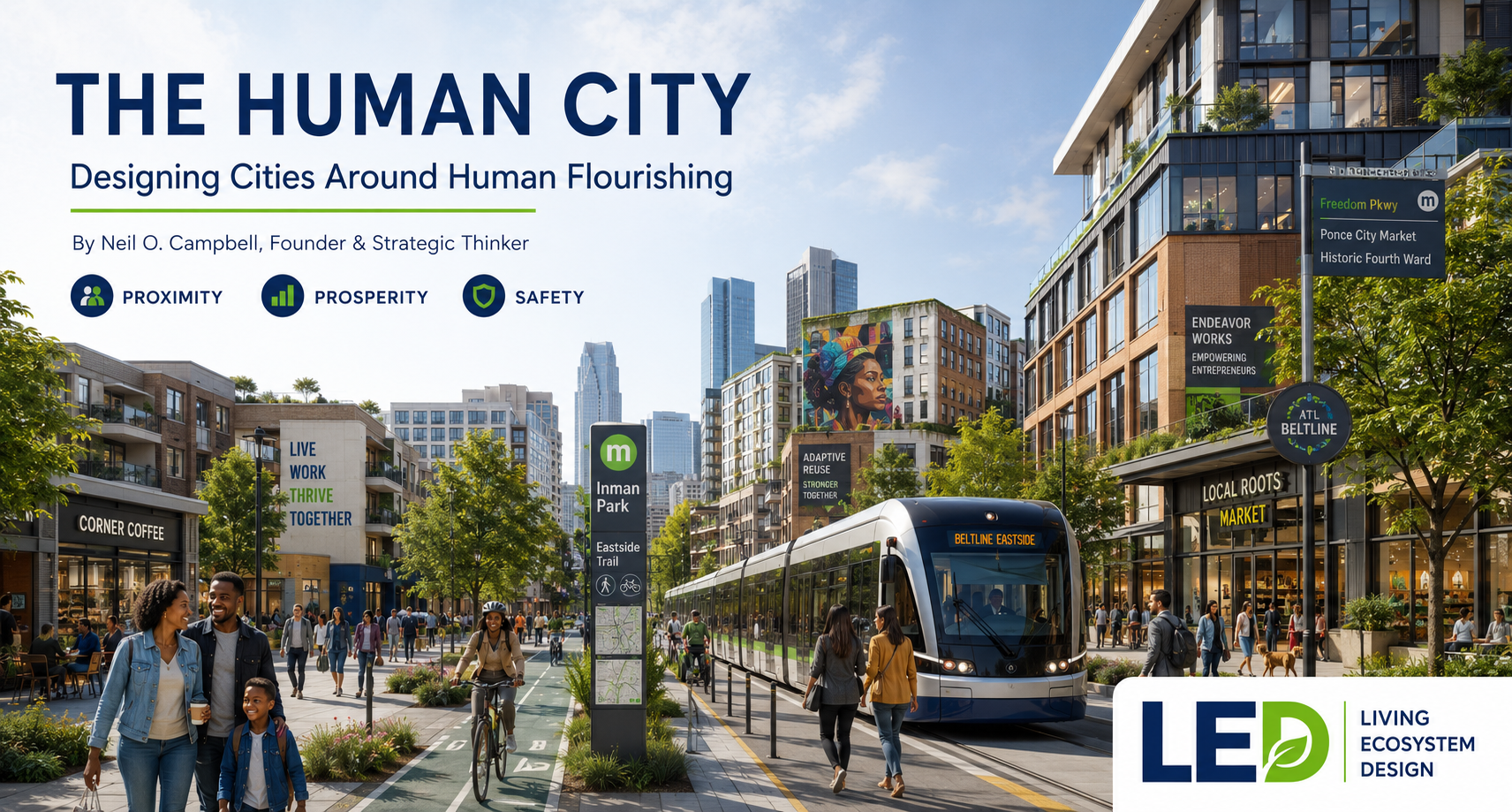
The Human City: Designing Cities Around Human Flourishing
THE HUMAN SERIES
By Neil O. Campbell Founder & Strategic Thinker
AN INSIGHT FROM LIVING ECOSYSTEM DESIGN (LED) / PART OF THE HUMAN SERIES
A Civic Innovation and Urban Systems Platform Atlanta Metropolitan Area, Georgia
The Human City
Designing Cities Around Human Flourishing
For most of modern history, we have measured cities by what they accumulate. We count buildings and permits. We count tax receipts, budget lines, and square footage. We celebrate skylines as though the skyline were the purpose of a city rather than a consequence of one. Yet a city has never been a collection of structures. A city is a collection of lives.
The Human City begins with a single correction. A city should not measure its success by the number of buildings it constructs, the taxes it collects, or the size of its budget. A city should measure its success by how effectively it improves the human experience. Everything else is a means. The human being is the end.
At Living Ecosystem Design, we hold that a city is a living ecosystem. Every department, every policy, every investment, and every public service is an organ within that ecosystem, and each exists for one purpose: to help people thrive. When we accept this premise, the work of government changes character. Budgets become instruments of human outcomes rather than ends in themselves. Zoning becomes a question of human access. Infrastructure becomes a question of human time. The city stops being a machine to be optimized and becomes a habitat to be cultivated.
The Human City rests on three foundational principles. Proximity, one of the most overlooked forms of public infrastructure, because every unnecessary mile between people and what they need is a hidden tax paid most of all in time. Prosperity, created through deliberate policy rather than chance, treating every resident first as a human asset capable of contributing value. And Safety, defined far beyond policing, delivered every time government responds quickly to a problem instead of leaving a resident to feel ignored.
Cities exist because people exist. The future of urban planning is not simply the smarter city or the more sustainable city. It is the Human City, a place designed so intentionally around human flourishing that every policy, every investment, and every institution advances the same purpose.
Continue reading the full article.